On this page
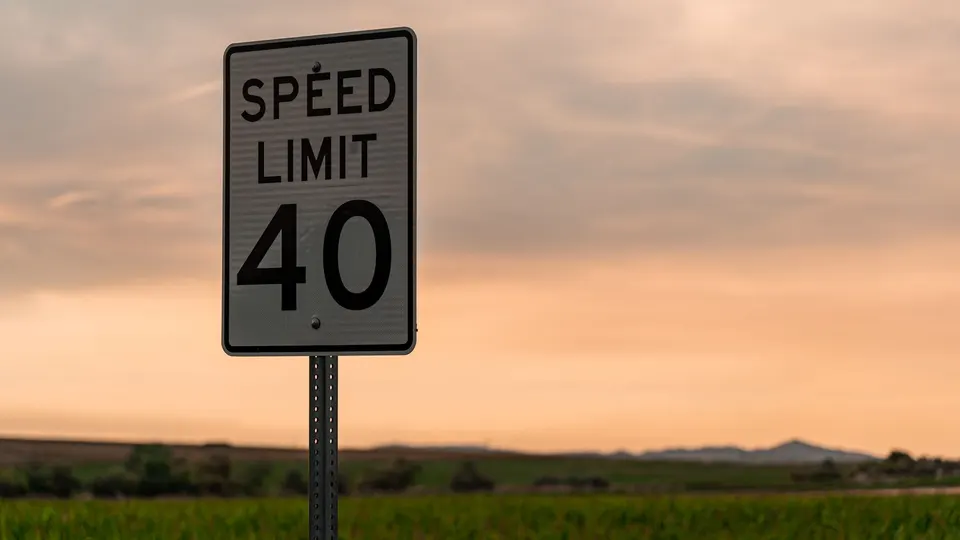
CVC 22349 is California's maximum speed law: 65 mph on most highways and 55 mph on two-lane undivided highways. A ticket totals $226.16 to $467.90 depending on speed and adds 1 point. Over 100 mph is charged under CVC 22348(b).
What does CVC 22349 prohibit?
Vehicle Code 22349 sets the maximum speed for California highways. It works as a number test: either you were over the limit or you were not.
- Subdivision (a) says no person may drive on a highway faster than 65 mph, except as provided in section 22356.
- Subdivision (b) sets 55 mph on a two-lane undivided highway, which the statute defines as a highway with no more than one through lane in each direction. A higher speed applies only if it is posted after an engineering and traffic survey.
These are maximums for the road type. If your citation says your speed was unsafe for the conditions rather than over a number, the charge is CVC 22350, the basic speed law.
How much is a 22349 ticket, by speed?
The Judicial Council's 2026 Uniform Bail and Penalty Schedule prices both subdivisions the same way. The amount depends on how far over the limit the officer says you were.
| Speed over | Base fine | Statewide total bail | DMV points |
|---|---|---|---|
| 1–15 mph | $35 | $226.16 | 1 point |
| 16–25 mph | $70 | $350.03 | 1 point |
| 26 mph or more | $100 | $467.90 | 1 point |
Total bail is the amount the court's schedule sets, and it includes the base fine, penalty assessments, a surcharge and two fixed assessments. That is why the totals dwarf the base fine. Counties can set their own totals, so your court's figure may differ. The ticket cost calculator breaks the total into its parts.
For the 55 mph rows under subdivision (b), the schedule gives the same base fines and totals, applied to speed over 55 mph.
When is the limit 70 mph?
Vehicle Code 22356 is the exception the 22349(a) text points to. The state Department of Transportation, with the approval of the California Highway Patrol, may declare a higher maximum speed of 70 mph, and it must have appropriate signs erected where it does.
That is why a 65 mph limit is not the whole picture on every highway. Read the signs on the road you were cited on; the date and location on your citation tell you which limit the officer relied on.
What is CVC 22348, the 100 mph law?
Vehicle Code 22348(b) prohibits driving over 100 mph. It is priced differently from every other speeding band.
| Item | 22348(b), over 100 mph |
|---|---|
| Judicial Council base fine | $200 |
| Judicial Council total bail | $860.80 |
| DMV points | 2 points |
The base fine is what the bail schedule starts from. A court sets the final amount on conviction, and the statute itself, not this guide, governs any penalties beyond the schedule. Read the charge on your citation and ask the court what applies to you.
How many points is a 22349 ticket?
A point is a mark the DMV adds to your record. Under VC 12810, other moving violations count as one point, and 22348(b) is listed at two. The schedule shows 1 point on every 22349 row. Only one violation arising from one occasion of arrest or citation is counted. Our page on DMV points explains the thresholds at which the DMV acts.
What are your options?
Start by reading which subdivision your citation names, (a) or (b), since the speed you are said to have exceeded depends on it. You have the same three choices as with any California ticket: pay it, ask for traffic school, or contest it in court or by written declaration.
- Pay. Paying in full is a bail forfeiture. The conviction is reported to the DMV and the chance to contest ends.
- Traffic school. If your court finds you eligible, completing it can lead to the conviction being held confidential (VC 41501). Only one conviction within 18 months will be held confidential. Rule 4.104 of the California Rules of Court excludes a speed more than 25 mph over the limit, so the 26 mph or more band does not qualify.
- Contest. Ask for a trial or file a written declaration. The traffic school or fight the ticket guide compares the routes.
For the other main speeding charge, read CVC 22350. If you are unsure of your total, use the calculator.
Frequently asked questions
Is 22349 different from 22350?
Yes. CVC 22349 sets fixed maximum speeds, so the question is whether you went over the number. CVC 22350 is the basic speed law and asks whether your speed was reasonable or prudent for the conditions. The 2026 schedule lists the same $226.16 to $467.90 totals and 1 point for both, but they are separate charges.
What is 22349(b)?
Subdivision (b) sets a maximum of 55 mph on a two-lane undivided highway, meaning one with no more than one through lane in each direction. A higher speed applies only where one is posted after an engineering and traffic survey. The 2026 schedule lists separate rows for it, with the same totals as subdivision (a).
Is going over 100 mph a misdemeanor in California?
VC 22348(b) is listed as an infraction. On the Judicial Council's 2026 schedule it carries a base fine of $200, a total bail of $860.80 and 2 points. This guide does not list the statute's separate penalties for repeat convictions. Read the charge on your citation and ask the court which penalties apply to you.
Can I take traffic school for a 22349 ticket?
Sometimes. A 22349 conviction carries a point. If your court finds you eligible, traffic school can lead to the conviction being held confidential under VC 41501, but not when you were more than 25 mph over the limit. Only one conviction within 18 months is held confidential. You also pay full bail plus fees.
Last reviewed · Reviewed by the California Ticket Guide editorial team